
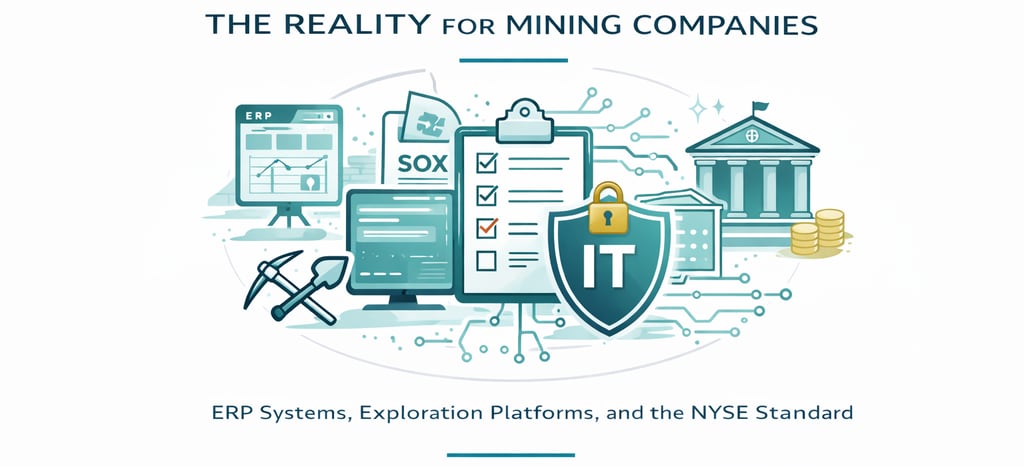
SOX & IT General Controls: The Reality for Mining Companies
ERP Systems, Exploration Platforms, and the NYSE Standard
THOUGHT LEADERSHIP
2/27/20263 min read
Disclaimer: This article appeared on the Sturnella website at sturnellahq.com. It is provided for informational purposes only and does not constitute investment advice, financial advice, or a solicitation to buy or sell any security. Sturnella is a capital markets cybersecurity and governance advisory firm. Always consult a qualified financial professional before making investment decisions.
For mining and resource companies preparing to list or uplist to the NYSE, cybersecurity conversations often focus on threat detection and vendor oversight.
But once public, a more fundamental issue emerges:
Are your financial systems controllable, testable, and audit-evidence-grade under SOX?
Most mining issuers operate:
An ERP platform (e.g., SAP, Oracle, NetSuite, Pronto, etc.)
Exploration and geological modeling systems
Production management platforms
Commodity trading or logistics systems
Cloud-based reporting tools
When listed in the U.S., the systems that feed financial reporting fall under Internal Control over Financial Reporting (ICFR) requirements.
That introduces IT General Controls (ITGCs) scrutiny.
The Shift: Operational Systems → Financial Control Systems
In private markets, ERP systems are designed for operational efficiency:
Payroll
Vendor payments
Inventory tracking
Capital expenditure management
Revenue recognition
In U.S. public markets, those same systems become:
Financial statement control infrastructure
Auditor-reviewed environments
Potential sources of material weaknesses
If one or more material weaknesses exist in ICFR, the company cannot assert that internal controls are effective.
That affects investor confidence immediately.
What Auditors Will Actually Examine
Under PCAOB standards, auditors use a top-down approach:
Identify financial statement risks
Determine significant accounts and disclosures
Trace to systems generating those figures
Evaluate controls over those systems
For mining and resource companies, this typically includes:
Revenue recognition from offtake agreements
Asset impairment calculations
Capitalized exploration costs
Joint venture accounting
Inventory valuation
Foreign subsidiary consolidation
If ERP or related systems support those numbers, ITGCs matter.
The Four Core ITGC Domains
Auditors generally pressure-test controls across four areas:
1. Access to Programs and Data
Who has administrative access?
Are privileged accounts monitored?
Is access periodically reviewed?
Are terminated employees removed promptly?
In small mining organizations, access is often informal.
That will not withstand SOX scrutiny.
2. Program Changes
Are ERP changes documented?
Is there segregation between developers and approvers?
Are production changes tested before deployment?
Exploration data systems often lack formal change management.
If those systems influence asset valuation, that becomes an ICFR issue.
3. Computer Operations
Are backups tested?
Are job failures monitored?
Is there evidence of system uptime oversight?
Operational resilience becomes a financial reporting issue when disruptions impact reporting accuracy.
4. Program Development
Are new modules implemented under controlled processes?
Are new financial reporting integrations validated?
Many mining and resource companies implement system upgrades during growth phases without formal documentation.
Public markets remove that flexibility.
The ERP & Exploration System Risk Overlap
Mining and resource companies face a unique complication:
Exploration systems and geological modeling tools influence:
Reserve reporting
Asset valuations
Capitalized exploration costs
Feasibility study assumptions
If those outputs affect financial statements, governance over those systems matters.
This is where many uplisting issuers are unprepared.
Exploration software may be:
Locally managed
Vendor-supported without formal assurance
Poorly integrated with ERP
Access-controlled informally
Under SOX, informal is insufficient.
The Vendor Control Trap
Many mining companies rely on:
Hosted ERP platforms
Cloud-based geological modeling systems
Outsourced data centers
Third-party IT support
Auditors will ask:
Do you have SOC 1 reports for finance-relevant vendors?
Have you reviewed them?
Have you implemented Complementary User Entity Controls (CUECs)?
Even if infrastructure is outsourced, management remains responsible.
Vendor reports do not replace internal oversight.
What CEOs Should Ask Before Uplisting
☐ Have we defined which systems are SOX-scoped?
☐ Do we know which systems feed financial statements?
☐ Are access controls formally reviewed and documented?
☐ Is change management evidence retained?
☐ Do finance-critical vendors provide SOC 1 Type 2 reports?
☐ Are CUECs mapped to internal controls?
☐ Would an auditor find consistent documentation across quarters?
If multiple answers are uncertain, uplisting compresses risk.
The Timing Reality
Many IPO advisors recommend beginning SOX readiness 18–24 months before listing.
Mining companies often delay this work until:
The registration statement is drafted
Auditors begin integrated testing
Comment letters arrive
That is late.
Control design cannot be rushed during filing season.
The Strategic Shift
For mining companies, SOX ITGC readiness is not about building an enterprise security operation.
It is about:
Making finance-relevant systems controllable
Defining ownership clearly
Generating consistent evidence
Aligning ERP governance with board oversight
The question is not:
“Are our systems secure?”
It is:
“Can we prove, quarter after quarter, that financial reporting systems are controlled and monitored?”
Conclusion
For resource companies pursuing NYSE listing, ERP and exploration systems quietly become part of regulated financial infrastructure.
Without formal ITGC discipline:
Auditors may identify deficiencies
Material weaknesses may be disclosed
Investor confidence may erode
Valuation may be affected
SOX readiness is not an IT exercise.
It is a capital markets requirement.
And for mining companies operating complex ERP and exploration platforms, it requires early, deliberate governance alignment.
Disclaimer: This article appeared on the Sturnella website at sturnellahq.com and is provided for informational purposes only. It does not constitute investment advice, financial advice, legal advice, or a solicitation to buy or sell any security or financial instrument. The information contained herein is based on publicly available sources and is believed to be accurate at the time of publication but is not guaranteed. Sturnella LLC is a capital markets cybersecurity and governance advisory firm and is not a registered investment adviser, broker-dealer, or financial institution. Always consult a qualified financial, legal, or investment professional before making any investment decision.
Contact
Reach out for discreet advisory support
contact@sturnellahq.com
Sturnella LLC © 2026 All rights reserved.
Independence
Governance Precision
Discretion
Capital Markets Alignment
Accountability
Our Values