
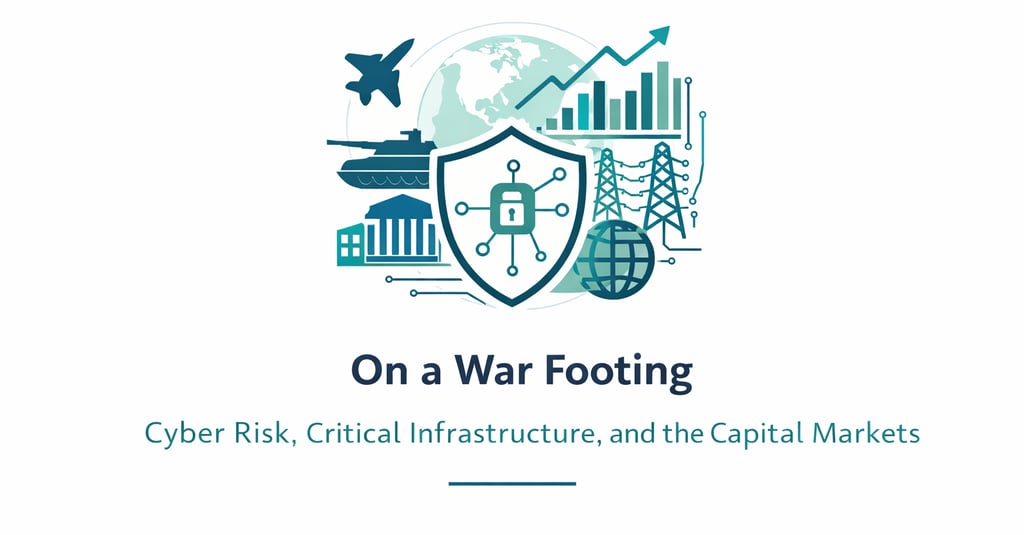
On a War Footing
What the Department of War’s CIO Priorities Mean for Capital Markets and Critical Infrastructure
THOUGHT LEADERSHIP
2/21/20264 min read
Disclaimer: This article appeared on the Sturnella website at sturnellahq.com. It is provided for informational purposes only and does not constitute investment advice, financial advice, or a solicitation to buy or sell any security. Sturnella is a capital markets cybersecurity and governance advisory firm. Always consult a qualified financial professional before making investment decisions.
When the War Department’s Chief Information Officer stated:
“Our mission is to support the warfighter … Everything we do should be supporting the warfighter community and their mission.”
she was not speaking about technology modernization in isolation.
She was articulating a structural shift.
Cybersecurity, AI, spectrum dominance, visibility, ruthless prioritization, accountability, and acquisition reform are no longer back-office concerns. They are mission-critical national security infrastructure.
And for companies operating in defense, mining, energy, critical materials, manufacturing, and capital markets — this matters profoundly.
1. We Are on a War Footing — Whether Markets Acknowledge It or Not
When defense leadership speaks about operating on a “war footing,” it signals:
Accelerated procurement cycles
Greater scrutiny of suppliers
Increased cybersecurity expectations
Stronger alignment between industrial capacity and national strategy
Companies embedded in defense-adjacent supply chains — or seeking to enter them — must assume that cybersecurity and governance standards will tighten, not relax.
This is not speculative.
It is structural.
Boards must now consider:
Is our cyber governance framework defensible under national security scrutiny?
Can we withstand visibility demands from defense procurement authorities?
Are our third-party dependencies transparent and auditable?
Operational risk is now national security risk.
And national security risk becomes capital markets risk.
2. “We Can’t Defend What We Can’t See” — Visibility as Valuation Risk
The emphasis on visibility is not just about asset inventory.
It is about:
Enterprise transparency
Supply chain traceability
System mapping
Data classification
AI model governance
Spectrum security
For public or pre-IPO companies, visibility failures are not merely technical gaps — they are disclosure exposures.
Under SEC cybersecurity disclosure frameworks, boards must understand:
Material cyber risk
Incident response posture
Governance structures
Third-party concentration exposure
If leadership cannot see its risk surface, it cannot accurately disclose it.
And if it cannot disclose it accurately, valuation is impaired.
3. Ruthless Prioritization — A Governance Imperative
“Ruthless prioritization” is not a slogan.
It is a governance discipline.
In capital markets contexts, companies often pursue broad cybersecurity initiatives without aligning them to:
Regulatory exposure
Transaction timelines
National security alignment
Board oversight capacity
Prioritization should begin with:
What would delay an IPO?
What would impair an acquisition?
What would trigger regulatory scrutiny?
What would undermine a defense contract?
Cybersecurity must be aligned to mission — and for commercial entities, that mission includes capital access and transaction certainty.
4. Accountability and Measured Outcomes — The End of Security Theater
“We will measure outcomes, not activity.”
This statement is as relevant to public company boards as it is to defense leadership.
Security metrics must shift from:
Activity-based reporting
Tool deployment counts
Audit checklists
to:
Reduction in material exposure
Governance maturity
Incident containment capability
Disclosure defensibility
In M&A environments, diligence teams increasingly assess whether cybersecurity programs demonstrate measurable risk reduction — not just procedural documentation.
Outcomes now influence price.
5. AI and Spectrum Dominance — The Next Layer of Governance Risk
The CIO’s emphasis on AI and spectrum security highlights a long-term structural shift.
For companies operating in:
Defense-adjacent manufacturing
Industrial systems
AI-enabled analytics
Critical infrastructure
AI governance is no longer experimental.
It is strategic.
Boards must now consider:
Model risk management
Data provenance and integrity
AI-driven decision transparency
Export controls and cross-border exposure
AI-enabled cyber threats
AI risk will increasingly be examined not only by regulators — but by underwriters and acquirers.
The companies that treat AI governance as a capital markets issue, not merely a technology initiative, will be better positioned.
Positioning for the Future: What This Means for Companies Today
If the defense ecosystem is aligning around resilience, agility, visibility, accountability, and AI-enabled modernization, companies supporting that ecosystem must align accordingly.
This requires:
IPO & Uplisting Readiness
Ensuring cybersecurity governance aligns with SEC disclosure expectations before market entry.
M&A Cyber and National Security Diligence
Understanding how operational and third-party risk impacts deal certainty and valuation.
Third-Party & Supply Chain Oversight
Mapping dependencies in defense, resource, and critical infrastructure ecosystems.
Board-Level Cyber Leadership
Translating operational exposure into governance decisions and defensible disclosure.
Mission Assurance & Procurement Alignment
Ensuring cybersecurity posture supports eligibility and competitiveness in defense-adjacent contracts.
The Strategic Reality
We are entering an environment where:
Cybersecurity is inseparable from industrial policy
AI governance is inseparable from national security
Supply chain risk is inseparable from capital markets scrutiny
Visibility is inseparable from valuation
Companies that recognize this early will be structurally advantaged.
Those that treat cybersecurity as an IT function will face friction — in procurement, in regulation, and in transactions.
The Myrtus Perspective
Myrtus operates where operational risk intersects with capital markets readiness and national security sensitivity.
We do not provide managed services.
We provide independent oversight and transaction-aligned advisory — ensuring that cyber and operational risk are aligned with disclosure clarity, governance precision, and valuation protection.
In an era increasingly defined by strategic competition and accelerated modernization, companies must think beyond compliance.
They must think in terms of mission alignment, capital access, and long-term resilience.
If your organization is preparing for an IPO, acquisition, defense-aligned procurement, or requires board-level cyber oversight in high-consequence sectors, we welcome a confidential discussion.
Contact: sydnie@mytrushq.com
Disclaimer: This article appeared on the Sturnella website at sturnellahq.com and is provided for informational purposes only. It does not constitute investment advice, financial advice, legal advice, or a solicitation to buy or sell any security or financial instrument. The information contained herein is based on publicly available sources and is believed to be accurate at the time of publication but is not guaranteed. Sturnella LLC is a capital markets cybersecurity and governance advisory firm and is not a registered investment adviser, broker-dealer, or financial institution. Always consult a qualified financial, legal, or investment professional before making any investment decision.
Contact
Reach out for discreet advisory support
contact@sturnellahq.com
Sturnella LLC © 2026 All rights reserved.
Independence
Governance Precision
Discretion
Capital Markets Alignment
Accountability
Our Values